A tarantula enclosure should be smaller, plainer and better ventilated than almost anything sold for the purpose in a pet shop. The spider does not want room to roam. It wants a secure retreat, a floor it can dig into or a wall it can climb, a full water dish, and a space small enough that prey walks past its front door.
That holds for every species, and it is about the only thing that does. A ground dweller, a burrower and a climber need three different boxes, and a quarter-inch spiderling needs a fourth. This guide sizes tarantula enclosures by leg span for each lifestyle, compares glass, acrylic and plastic, settles the front or top opening question, and covers what changes from sling to adult.
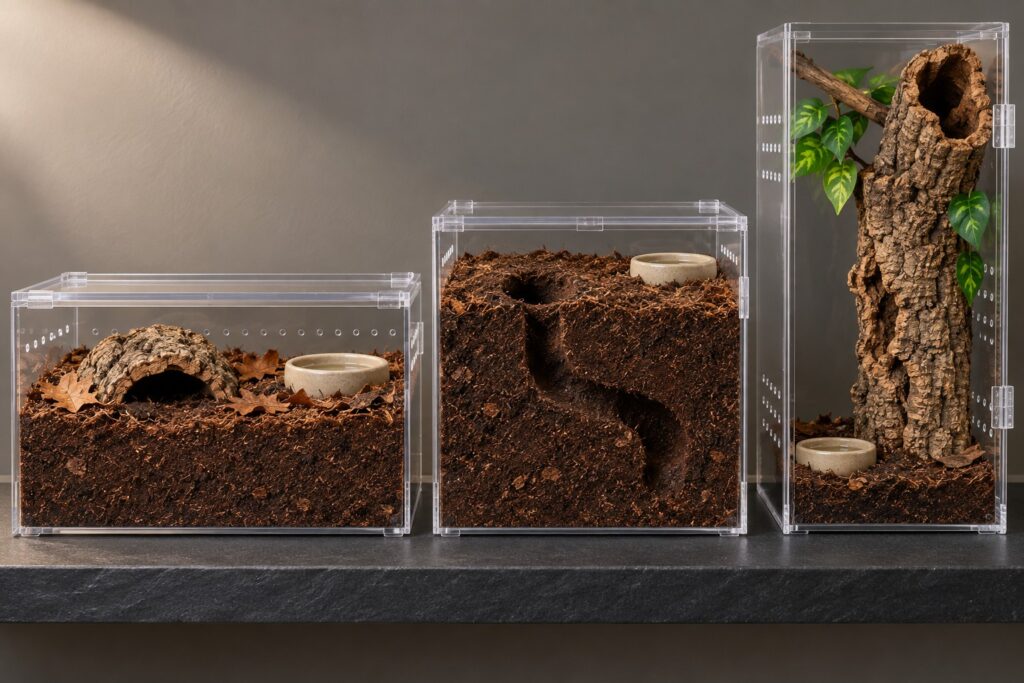
Start With How Your Tarantula Lives
Every number further down depends on which of three lifestyles your species follows. Look that up before you buy anything.
Terrestrial species live on the surface and use a hide or a shallow scrape. Most beginner tarantulas sit here, including Grammostola, Brachypelma, Tliltocatl and many Aphonopelma. They are heavy bodied and bad at falling, so the box is wide, low and mostly filled with substrate. The detailed version is in our walkthrough on building a terrestrial tarantula enclosure.
Fossorial species dig a burrow and live in it, sometimes for months without showing themselves. Ceratogyrus, Cyriopagopus and Hysterocrates are the classic examples. They take the same footprint as a terrestrial with far deeper substrate.
Arboreal species live off the ground on bark and web a silk tube to hide in. Avicularia such as the common pink toe, along with Caribena, Psalmopoeus and Poecilotheria, all belong here. Their box is tall, narrow, light on substrate and heavy on airflow, and we cover it step by step in setting up an arboreal tarantula enclosure.
| Terrestrial | Fossorial | Arboreal | |
|---|---|---|---|
| Dimension that matters | Floor space | Substrate depth | Height |
| Adult substrate | 3 to 5 inches | 6 to 10 inches | 1 to 2 inches |
| Retreat | Cork hide on the surface | A burrow it digs itself | Vertical cork tube or slab |
| Ventilation | Moderate cross flow | Moderate cross flow | Generous cross flow |
| Best access | Top | Top | Front |
| Biggest risk | A fall from height | Loose substrate collapsing | Stagnant humid air |
Two caveats. Lifestyle shifts with age: slings of many terrestrial species burrow hard and grow out of it, and arboreal slings often dig before they climb. Lifestyle also tells you nothing about temperament. How fast and how defensive a spider is depends far more on whether it is an Old World or a New World species, and that changes how you want the enclosure to open.
Tarantula Enclosure Size Chart by Leg Span
Tarantulas are measured by diagonal leg span, shortened to DLS: the distance from the tip of a front leg to the tip of the opposite rear leg with the spider at rest. Sellers quote it, and every sizing rule in the hobby is built on it. If you cannot measure the animal, measure a shed exoskeleton laid flat and add a little.
| Leg span (DLS) | Terrestrial footprint | Fossorial | Arboreal height | Typical container |
|---|---|---|---|---|
| Under 1 inch | 2 to 3 inches across | Same footprint, two thirds full of substrate | 4 to 6 inches | Vial or 2 to 4 oz deli cup |
| 1 to 2 inches | 4 to 6 inches across | Same footprint, 3 to 4 inches of substrate | 6 to 8 inches | 16 to 32 oz deli cup, stood upright for arboreals |
| 2 to 3.5 inches | 6 to 10 inches across | Same footprint, 4 to 6 inches of substrate | 8 to 12 inches | Small acrylic box or small plastic tub |
| 3.5 to 5 inches | 8 to 12 inches across | Same footprint, 6 to 8 inches of substrate | 12 to 16 inches | Medium acrylic or 5 gallon tank |
| Over 5 inches | 12 by 12 inches or more | Same footprint, 8 to 10 inches of substrate | 16 to 18 inches | 10 gallon tank or large acrylic |
Three rules sit behind those numbers, and they are worth knowing so you can size a container the chart does not list.
The floor rule. For ground dwellers and burrowers, width and depth should each be two to three times the leg span. That is enough room to turn, walk and place a hide and a dish, and not so much that the spider loses track of its food.
The height rule. For terrestrial species, the open air between the substrate surface and the lid should be no more than 1.5 times the leg span. A plump terrestrial that climbs the wall and drops can split its abdomen, and that injury is usually fatal. Measure from the substrate, not from the floor of the container. A 5 inch spider in a 10 gallon tank needs roughly 4.5 inches of substrate to bring the air gap down to 7.5 inches.
The arboreal ratio. For climbers, flip it. Height should be two to three times the width, with the footprint only wide enough to stand a cork tube in. An adult pink toe does well in something about 8 by 8 inches and 12 or more inches tall. The fall rule does not apply, because arboreals are lighter and catch themselves.
Bigger is not kinder. An oversized box means prey that never crosses the spider’s path, a retreat you cannot find, and in the terrestrial case extra fall height. A 10 gallon tank is the ceiling for nearly every ground dweller in the hobby. The handful of giants that pass 8 inches, the Theraphosa and Lasiodora species, are the exception and want a footprint closer to 18 or 20 inches on the long side.
Substrate Depth Sets the Real Size
Substrate is the part of the enclosure the spider actually uses, and its depth is what turns a generic container into the right one. The same 10 gallon tank is a terrestrial setup with 4 inches of substrate, a fossorial one with 9, and wrong for an arboreal either way.
| Life stage | Terrestrial | Fossorial | Arboreal |
|---|---|---|---|
| Sling, under 1.5 inches | Two thirds of the container height | Two thirds or more | A third to half, since many burrow at first |
| Juvenile, 1.5 to 3.5 inches | 2 to 4 inches | 4 to 6 inches | About 1 inch |
| Adult | 3 to 5 inches | 6 to 10 inches, roughly three times leg span | 1 to 2 inches |
What to use. Plain coconut fibre works and is what most keepers start with. Its weakness is structure: it does not hold a tunnel. For anything that digs, a mix of three parts coconut fibre, two parts additive-free topsoil and one part play sand packs far better.
Pack it down. Add substrate slightly damp and press it in layers until it holds a thumbprint. Loose, fluffy fill collapses on a digging spider and gives a burrow nothing to grip. The same test applies to other burrowing predators, which is why packing the substrate for a centipede enclosure follows identical logic.
Moisture is a species question, not a lifestyle one. Arid ground dwellers want dry substrate and a full dish, and an adult chaco golden knee is the textbook case. Tropical species want one damp section, made by pouring water down a corner so it soaks in. Misting wets the surface for an hour and annoys the spider.
What to leave out. Gravel, bark chips as a base, cedar or pine shavings, reptile calcium sand, and anything scented or sold with additives.
Glass Tank, Acrylic Box or Plastic Tub
People search for a tarantula tank, a tarantula terrarium and a tarantula cage as if they were one product. They are three different materials with different strengths, and the cheapest of them is often the best choice.
| Material | Strengths | Weaknesses | Best for |
|---|---|---|---|
| Glass tank or terrarium | Clear, scratch resistant, holds moisture well, easy to find second hand | Heavy, hard to drill for side vents, usually sold with a mesh lid | Large adult terrestrials and fossorials |
| Acrylic enclosure | Light, very clear, easy to drill, often built with cross vents and a hinged or magnetic door | Scratches easily, can bow in damp setups, costs more per inch | Arboreals, display animals, juveniles upward |
| Plastic tub or deli cup | Cheap, stackable, holes go wherever you want them, lids lock down | Cloudy, not much to look at | Slings, juveniles, large collections |
Glass. An ordinary aquarium makes a perfectly good home for a big ground dweller once you deal with the lid. Screen mesh is the problem. A tarantula’s tarsal claws, the tiny paired hooks at the end of each foot, catch in the weave, and a spider hanging from the lid by one snagged foot can lose the leg or fall. Replace mesh with a sheet of drilled acrylic cut to fit, or cover the underside with one. Front-opening glass terrariums made for reptiles suit arboreals for height, but check the gaps around the doors and cable ports against the size of your spider, and treat the mesh top the same way.
Acrylic. A purpose-built acrylic tarantula enclosure is the easiest way to get cross ventilation and sensible access in one purchase. Vents are already drilled on opposing walls, arboreal models open at the front, and the weight is trivial. Clean acrylic with a soft cloth and water only, since paper towel leaves fine scratches and solvent cleaners cloud it.
Plastic. Clear storage tubs and deli cups house a large share of the tarantulas in serious collections, and the spiders do not know the difference. A soldering iron or a heated pin puts ventilation exactly where you want it. If you intend to keep more than a few animals, this is how the numbers stay affordable.
Wire and mesh-sided cages are the one option to rule out. They cannot hold moisture, they catch claws on every wall, and small spiders walk straight through them.
Front Opening or Top Opening
Which way the enclosure opens decides how every feeding and water change goes.
Top opening suits ground dwellers and burrowers. The spider is below you, its instinct is to retreat down or under the hide, and a deep substrate layer would sit above the sill of a front door anyway. Nearly all terrestrial and fossorial setups open from above.
Front opening suits climbers. An arboreal that bolts goes up. Lift a lid and that route leads out of the box and onto your arm. A front door lets you work at substrate level while the spider sits in its retreat near the top.
For fast species, think about distance. With a quick Old World animal of any lifestyle, the aim is an opening as far from the retreat as possible and no bigger than the job needs. A small feeding hatch beats a full lid.
A free fix for small arboreals: stand a deli cup on its end so the lid becomes a side wall. You get side access at no cost.
Ventilation: Two Walls, Not Just the Lid
Air needs a way in and a different way out. Holes in the lid alone give you a still column of air sitting on damp substrate, which is how mold starts.
Place vents on opposing walls. A band of holes low on one side, just above the substrate line, and a second band high on the opposite side lets air cross the enclosure as it warms and rises.
Size holes to the spider. Nothing wider than the carapace, the hard plate on the front half of the body. Slings get pinholes. They leave through gaps that look impossible.
Match the amount to the lifestyle. Terrestrial and fossorial species need moderate airflow. Arboreals need a lot, and the Avicularia pink toes in particular decline in closed, humid boxes. Old caresheets told keepers to seal those enclosures and mist heavily, and that advice is now widely blamed for years of unexplained losses.
Fix humidity with water, not by blocking vents. If the enclosure dries too fast, wet a larger section of substrate. If you see mold, add holes before you change anything else.
From Vial to Final Home: Enclosures by Life Stage
A tarantula bought as a sling will live in three or four containers before it settles into its last one. Each stage has a different priority.
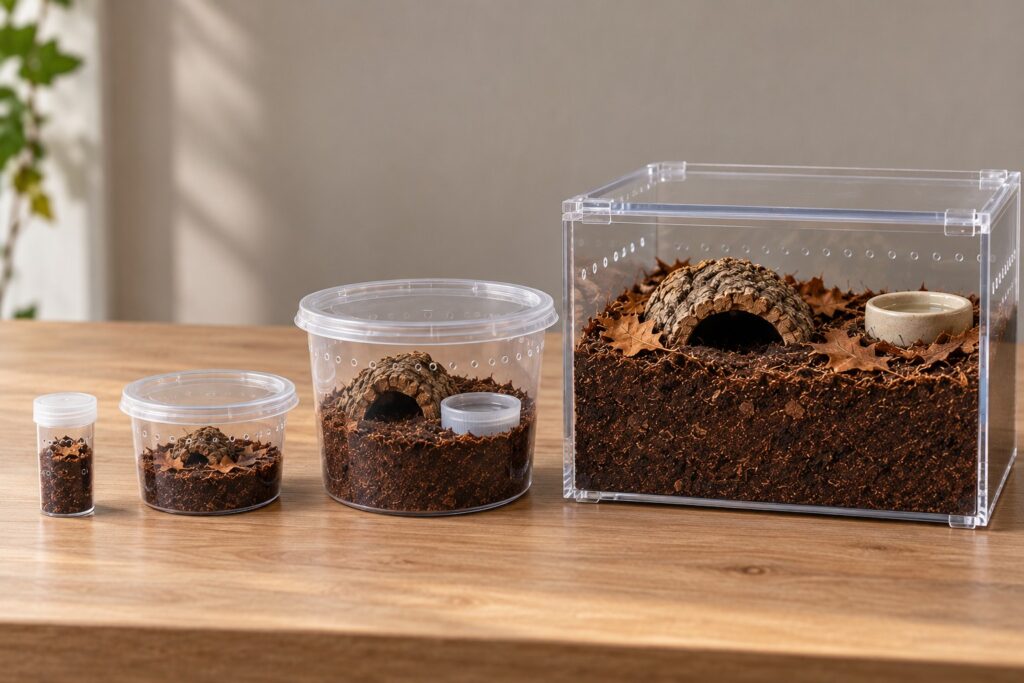
Sling, under about 1.5 inches. A vial or a small deli cup roughly three times the leg span across. Small is the point: a sling in a big box cannot find food and you cannot find the sling. No water dish below about 0.75 inches, because a tiny spider can drown in one, so put droplets on the wall and keep one corner of the substrate damp. Prey size, moisture and molt timing at this stage are covered in our guide to spiderling housing and feeding.
Juvenile, 1.5 to 3.5 inches. A 32 oz deli cup or a small acrylic box. Add a bottle cap as a water dish and keep it full from here on. This is when the adult lifestyle shows up: terrestrials stop burrowing and start using the hide, and arboreals leave the substrate for the cork. Cheap plastic still makes the most sense, because the spider will outgrow whatever you buy within a year or so.
Adult. This is the enclosure worth spending on. A female of a long-lived genus can occupy it for fifteen or twenty years, so choose something you like looking at and can service easily. Mature males are the exception. They stop growing after the final molt, wander constantly looking for a mate, and live only months to a couple of years, so there is no need to upgrade them.
What Goes Inside the Box
Furnishing is short, and most of what gets sold as decor is for the keeper.
- A retreat. Half a cork round bedded into the substrate for ground dwellers, with a starter divot underneath. A vertical cork tube running most of the height for arboreals, with a gap behind it if you use a flat slab. Fossorials want a starter hole and will handle the rest.
- A water dish. Shallow, stable, always full, for anything over about 1.5 inches. Skip sponges, gel and pebbles. An adult tarantula does not drown in a shallow dish, and sponges only grow bacteria.
- Anchor points. Dry leaf litter on the floor, or artificial foliage near the top of an arboreal setup, gives silk something to attach to.
- Nothing hard or tall for ground dwellers. Stacked rocks and tall ornaments are things to fall onto.
Live plants and bioactive builds are possible, but they demand the moisture and light that suit the plant, and they are a poor match for arid species.
Heat, Light and Where the Enclosure Sits
Temperature. Room temperature covers nearly everything commonly kept: 70 to 80F (21 to 27C). If your home runs colder, fix a low wattage heat mat to a side wall on a thermostat. Never put it underneath. A tarantula that feels too warm digs down to cool off, and a mat under the floor means it digs toward the heat.
No heat lamps. They dry a small enclosure in hours, and dehydration is the most common preventable cause of death in captive tarantulas. It shows as legs curling under the body, and it starts with an empty dish.
No special lighting. Tarantulas need no UVB and prefer dim conditions. Ordinary room light through the day is enough to set a day and night rhythm.
Placement. Keep the enclosure out of direct sun, which turns any clear box into an oven within minutes. Use a stable shelf away from speakers and slamming doors, since tarantulas read vibration as a threat. Keep it well away from aerosol sprays, plug-in insecticides and flea treatments for other pets.
When It Is Time to Rehouse
Move a spider up a size when its leg span passes about half the width of the container, when a hide and a water dish no longer fit side by side, or when an arboreal’s silk tube runs the full height of the box.
Timing matters as much as size. Never rehouse a tarantula in pre-molt, recognisable by a dark, tight abdomen and a refusal to eat, and wait one to two weeks after a molt so the new exoskeleton has hardened. Prepare the new enclosure completely first, work inside a large empty bin, keep a catch cup in your hand, and move the hide or cork tube with the spider inside it whenever you can.
Because the safe window depends on the last molt, the date is worth having. When a spider molts, log it in InvertMate and you will know later whether a rehouse can go ahead or should wait a week.
Seven Tarantula Enclosure Mistakes That Cost Spiders
- Too much open height over a terrestrial. The most serious error, and the reason for the 1.5 times leg span rule.
- A box several sizes too big. Prey gets lost and so does the spider.
- An uncovered mesh lid. Claws snag and legs get lost.
- Lid-only ventilation. Still, damp air and mold.
- A heat mat underneath. It cooks the layer the spider retreats into.
- Loose substrate for a digger. Burrows collapse.
- A terrestrial build for an arboreal, or the reverse. Check the lifestyle before buying the box.
FAQ
What size enclosure does a tarantula need?
For terrestrial and fossorial species, two to three times the leg span in width and depth, with no more than 1.5 times the leg span of open air above the substrate for terrestrials. For arboreal species, a height two to three times the width, reaching 12 to 18 inches for an adult.
Is an acrylic tarantula enclosure better than glass?
For most keepers, yes. Acrylic is lighter, easy to drill, and usually comes with cross ventilation and front access already built in. Glass resists scratches and holds moisture better, which suits large terrestrial and fossorial adults. Plastic tubs beat both on price for slings and juveniles.
Can I use a fish tank as a tarantula tank?
Yes, for ground dwellers and burrowers. A 5 or 10 gallon aquarium works well once you fill it with enough substrate to meet the height rule and swap the screen lid for drilled acrylic. Standard fish tanks are too wide and too short for arboreal species.
What size is a pink toe tarantula enclosure?
About 8 by 8 inches across and at least 12 inches tall for an adult, front opening, with vents on two opposing walls. Pink toes need more airflow than almost any other commonly kept tarantula, so ventilation matters more than the exact dimensions.
Can a tarantula terrarium be too big?
Yes. In an oversized terrarium the spider struggles to find prey, uneaten insects hide and bother it during a molt, and you lose sight of the animal. For terrestrial species, extra size usually also means extra fall height. Size to the leg span, not to what looks generous.
Are mesh tarantula cages safe?
Not as sold. A tarantula’s tarsal claws catch in screen mesh, and a spider hanging by a trapped foot can lose the leg or fall. Mesh-sided cages also cannot hold moisture. Use solid walls with drilled holes, and cover or replace any mesh lid.
Which Box Was Rehoused When?
When did the juvenile in the third deli cup last molt, and how long has the big female been in her current tank? With one tarantula you remember. With six you start guessing. InvertMate keeps molt and rehousing dates against every animal, records temperature and humidity for each enclosure, and sends reminders for water dish checks. Free on the App Store and Google Play.